We asked Shirley van de Voorde, who did a 5 month volunteer internship with us at NVT, to write a guest blog on her time with us – thanks Shirley!

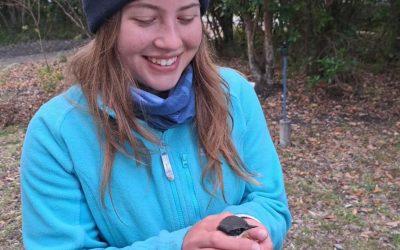
Shirley holding a African Black Oystercatcher chick
One of the things that you need to do for my Bachelor-study Coastal Zone Management is doing two internships of 5 months, one in the second year and one in the third or fourth year (I will explain this later). In December 2012 my university decided to change the internships for the 2nd year from the 2nd semester to 1st semester, from September 2013 till January 2014. After hearing this I decided to have two goals for place where I would like to do an internship; going abroad to another continent for the first time and if possible to the South Hemisphere. After sending lots of emails (more than 30) all around the world, a year ago I got an email back from Dr Mark Brown with the final answer: I was welcome to join the Nature’s Valley Trust for an internship and was able to do an awesome project!
Now a year later after that email, I have been back in my home country the Netherlands for a month and I can say that I had the most amazing time of my life in South Africa! When family and friend ask me the question; ‘What was the most amazing experience during your time in South Africa’, I can’t answer this question with one thing. There are so many experiences that were great in their own way.

Shirley back home in the cold!
But what did I actually do at the Nature’s Valley Trust??
I was involved in all the different sections of Nature’s Valley Trust; Environmental Education, Community, Conservation and Research. Things that I’ve done for the Community and Environmental Education programs were: helping with the clean-up in Kurland; helping Nelishka during the Hobbit trail lessons where the children and I learned about the trees and forest; during the NVT holiday program helping with the Rocky Shore Experience exploring the rocky shore, NVT day camp face painting children and helping with the games and helping with the Triathlon; Big Birding Experience where the school-children learned about birding and how much fun this is and a lot of other things.
Most of the time I was involved with the Conservation and Research sections of NVT. I have helped Nelishka with the Fynbos research; getting bags and cages over the flowers; catching mosquito fish with Babalwa for her research; trapping raptors and ringing them with Mark and Minke, Bird Ringing getting the birds out of the nets and trapping lots of Kelp Gulls for Minke’s Kelp Gull research project. But I didn’t only do work for their projects, I also had my own project to run.

Shirley releasing a Pale Chanting Goshawk.

Shirly with learners of Crags Primary School During the Big Birding Experience.
My own little project??
The project that I ran during my time for NVT was titled: ‘The influence of human disturbance on African Black Oystercatcher and Kelp Gull breeding at Plettenberg Bay’. This project was done on Robberg Nature Reserve and Keurbooms Nature Reserve, which had two study areas: Lookout Beach and Keurbooms Peninsula. I monitored all the African Black Oystercatcher nests that I could fine on my three study areas. There were 8 nests on the Peninsula, laying in total 13 eggs of which 3 eggs/chicks were predated, 4 eggs/chicks died a natural death and 5 of the eggs hatched. On Lookout there were 7 nests laying in total 14 eggs of which 8 eggs/chicks were predated, 1 egg/chick died a natural death and 5 of the eggs hatched. Robberg had the highest predation rate of all the areas, 8 of 12 eggs laid over 5 nests were predated. Scary facts!

African Black Oyestercatcher eggs hatching.
To collect the data for the disturbance I did un-manipulated disturbance trials and manipulated disturbance trials. For the un-manipulated disturbance trails I sat and observed the behavioural reactions of the birds to walkers, sunbathers/picnickers, joggers and dogs either on/off the leash. Manipulated disturbance trials involved walking in a straight line to a bird (on a nest during breeding season) and dropped markers when behavioural reactions were displayed. I then measured the distance from the nest to each marker to get an idea of how far we (humans) need to be from the breeding birds to prevent disturbing the birds.

Shirley during her disturbance research field work.
As the research progressed I noticed different behavioural reactions in the breeding African Black Oystercatchers and Kelp Gulls. Breeding oystercatchers incubating eggs would initially walk off the nest before calling on direct approach while gulls would initially starting calling and then walk off the nest, and if you go too close would begin mobbing. This is due to different nest protection strategies: the oystercatcher protects it’s nest through camouflage and distraction while the gull protects it’s nest through aggression and intimidation. Aggressive gulls are the reason that hard hats, seemingly ridiculous on the beach, became necessary; having your head attacked by a protective gull is not at all pleasant!
Not only were the order of reactions different between species, but I also discovered that the oystercatchers were more sensitive to my approach and would react when I was much further away from the nest than the gulls did, where I could come much closer. Another trend that was seen was the difference in reaction distances between the 3 study sites. Both species were more sensitive to my approach at Lookout, and walked off the nests sooner than in the other 2 areas. The birds on Robberg reacted the slowest of all 3 study sites. This may be due to the breeding site location: birds nesting on cliff edges may struggle to see my approach while birds nesting in open areas may be more accustomed to the presence of people who are restricted to the boardwalk.
Another aspect of the project looked at how long it took birds to return to the nest as well as how long it took them to continue brooding. There was a big difference in time between the two species. Gulls returned very quickly, while the oystercatchers took far more time to return back ensuring that the location of the nest was as concealed as possible. Looking at these results over the 3 study sites showed that return times for gulls were quite similar over 3 sites, while the oystercatcher had the fastest and lowest return and brooding times on Robberg. This can be explained by differing nest locations.

Shirley on top of Table Mountain.

Shirley holding an African Elephant for the first time

Shirley swimming with seals.
On the 23rd of January I left Plettenberg Bay, the Nature’s Valley Trust team and my birds to fly home to my home country the Netherlands. Mark and Minke are still busy collecting data for me, so that we have data for the whole breeding season of the oystercatchers and the kelp gulls. It’s nice that they finish this project, because than we have the whole data set for this season and it is also better for the scientific article that I’m writing (with supervising of Mark and Minke fortunately!) and that we hope to publish in a few months. I didn’t expect that I would write a scientific article during this internship, but Mark and Minke challenged me with this. After being in Plett for a week, Mark and Minke told me that I would write a scientific article. I told them that I would accept the challenge, but that I wasn’t sure if I would make it. English is my second language and writing a scientific article was quite new for me, but they supervised me very well and I’m getting more comfortable with the writing and the English. If you had told me that I would write a scientific article during this internship in forehand, I wouldn’t believe that I would make it. I challenged myself with something that I’m not comfortable with, but if you don’t give it a try you will never know if you can make it.
South Africa is a great country and because English is for a lot of South Africans their second language they are used to my English not being as perfect as a first language speaking person. People accept it when you say things a bit different or you mix it with you first language, which I sometimes did. Instead of ‘measurement tape’, I said for the first 3 months ‘measurement lint’ which is a combination of English and Dutch. But this was also a nice way to teach Minke a little bit Dutch and she did understand what I was saying, hahaha.

Partners in crime… shirley and Minke in the field
My South African life…
I lived In Plettenberg Bay. I worked with Minke most of the time, and we spent most of our spare time doing crafts, going to the beach for a walk, Pico’s pizza and movie nights, doing a PADI Open Water Diver course together, going to Surf Café for supper or going to her friends, who became my friends too. I also spent time at the White House with my other colleagues and thing that I did with them was watching movies, defrosting the freezer and used the ice to have a snowball fight in South Africa, letting Yola cycle for the first time, going to hike on Tsitsikamma National Park, going to the cinema, going out, going shopping in Knysna and lot of other things. But I also spent time with Mark’s family, who were very nice to me and it was special for me that they had me (a stranger, who they didn’t know me) in their house and letting me celebrate Christmas at their house.