The Tsitsikamma Fynbos Research Program was launched by the Nature’s Valley Trust on 17th April 2013. We can hardly believe that a whole year has gone by already! This program is one of several research collaborations between SANParks and NVT, collecting essential data needed to manage this spectacular part of the world. This particular program focuses in on Fynbos, one of only SIX plant Kingdoms found globally, and completely endemic to South Africa. With a level of biodiversity comparable to tropical rainforests, there is surprisingly little research being done in the Fynbos at present, especially in the Bitou region where NVT is placed. Having aligned ourselves to the Cape Action Plan for People and the Environment (C.A.P.E.) strategy, and having spent time looking at research priorities identified by the Fynbos Forum Research Strategy, we set out a year ago to make a positive contribution to Fynbos research and conservation in our region. So what exactly have we got up to in this program over the last 12 months? Well I am glad you asked! There are two main areas we have been focusing on – namely long term monitoring of bird movements, and studies on particular plant species and their pollinators.

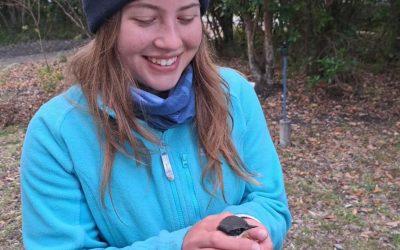
On the bird front, we have been setting up mistnets to trap, ring and release birds in the Fynbos every two weeks on the R102 section of Fynbos in the Tsitsikamma section of the Garden Route National Park, just above Nature’s Valley. We have also periodically ringed birds in the Fynbos Reserve and Padda Puddle within Nature’s Valley itself. The results are fabulous! We have netted around 800 birds of about 30 different species in the first year! This included just over 100 Cape Sugarbirds, 30 Orange-breasted Sunbirds, 150 Southern Double-collared Sunbirds and 325 Cape White-eyes, which are important pollinator species in the Fynbos. What is more interesting is the recapture rate for each of these species… We only recaught 2% of the Cape Sugarbirds, which reflects just how nomadic this species is. In stark contrast, we retrapped 24% of the Orange-breasted Sunbirds, which suggests a much higher resident population of this species. This is reflected in the flowering of the main plants they pollinate – Cape Sugarbirds are the primary pollinator for many Protea species (so birds move widely between different populations as and when they flower), while Orange-breasted Sunbirds are implicated as important pollinators for many of the bright red Erica species. With different Erica’s flowering almost every month in this region, the sunbirds can mostly stay put… We have had one AMAZING movement recorded by a Sugarbird so far, moving from our site, where we ringed it on 19th June 2013, to be recaptured by Dr Alan Lee at Blue Hills Escape Nature Reserve in the Baviaanskloof on the 16th October 2013! The direct line distance of 43km is the second longest recorded movement for the species so far, and shows how these magnificent birds can move in a fragmented landscape. This is why the Nature’s Valley Trust has nature’s Valley and it’s surrounds in our mission statement!

The nets set up to catch birds

A stunning male Orange-breasted Sunbird

The magnificent Cape Sugarbird

A Cape Sugarbird feeding on Protea neriifolia
Of interest we have also caught several “forest” bird species in the mature stand of Fynbos along the R102 including White-starred Robin, Knysna and Olive Woodpeckers, Scaly-throated Honeyguides, Forest Canaries, Blue-mantled Crested Flycatchers, Collared Sunbirds and other forest and thicket species like Cape Batis, Olive Bush-shrike, Yellow-throated Woodland Warbler and Bar-throated Apalis. I so appreciate the help from the whole NVT team on this project (especially for the early morning starts!), and especially Minke Witteveen our other resident NVT ringer who makes it all so easy for me!
An unusual finding was the presence of White-browed Scrub-Robins not supposed to be in the Western Cape (very few records historically!), yet we have netted three so far… Silly birds don’t read the books! Actually, there is a range of species expanding their range westwards,and we will pick these up…

An out of range White-browed Scrub Robin
Our Fynbos bird program is also linked to SANBI’s birds and climate change Fynbos program, run by Dr Phoebe Barnard, one of South Africa’s leading climate change scientists. We are the local partner in this region for Phoebe’s long term work, and have already contributed to an excellent MSc thesis done by Beth Mackay at UCT entitled “Climate Change and Sustainable Development” Beth investigated the influence of urbanisation and climate on tarsal infections in Cape Sugarbirds and used our data extensively.
On the botanical side, we have been studying the pollination systems of a range of local Fynbos species, most notably Erica discolor, Kniphofia uvaria, a Watsonia species andBrunsvigia orientalis. To work out what the main pollinators of a plant are, we bag (exclude all pollinators) and cage (exclude birds) some flower buds before they open. This allows us to see if the plant can self-pollinate (where’s the fun in that?), whether birds are the most important pollen vectors, or if insects like bees play the biggest role. We also measure flowers quantify how much nectar they produce and see what concentration of sugar is in the nectar, all of which helps us identify the pollinators. We were fortunate to have had excellent teams working on these projects over the last year and need to thank Eliška Padyšáková, a PhD student from the Czech Republic who spent 6 weeks with us last year setting up this program with me. Thanks also to Monica Taylor from Offshore Adventures and Minke Witteveen (NVT research student) who ran the Brunsvigia project early in 2014. Thanks to all the NVT interns for all their help in the field.

The birds and the bees… Which are more important as pollinators in some species?
Another aspect of our work with plants involves trying to document all the species occurring in this section of the park. To this end, our team have been uploading pics toiSpot, a virtual museum run by SANBI, enabling users to upload photos of different biodiversity groups where experts will identify your specimen! Not only do we learnt through this process but our data then sits on a national database, adding local knowledge to a national project. Kellyn Whitehead one of our interns, currently manages this aspect of the project for us – thanks Kellyn!

Photographing flowers for iSpot
So, all in all a successful first year for the project, and we look forward to more exciting results in the on the Tsitsikamma Fynbos Research Program in the months to come!